Pants hangers with clips are generally better when retailers want to display the full length of trousers or skirts. Trouser bar hangers are often more practical when garments can be folded and vertical display space is limited. Neither design is automatically better for every fabric, garment or store layout.
For apparel brands, retail chains and wholesale buyers, the decision involves more than appearance. Clip pressure, bar surface, garment shape, fixture clearance and handling requirements all affect whether a hanger is suitable.
This guide compares the two designs and explains how to evaluate samples, select suitable styles and prepare specifications before placing a bulk order.
The Core Difference: How Clips and Trouser Bars Hold Garments
The main difference is how each hanger supports the garment.
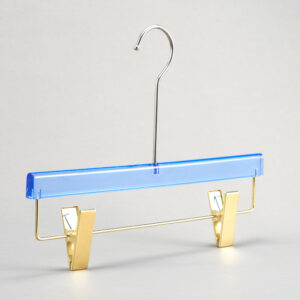
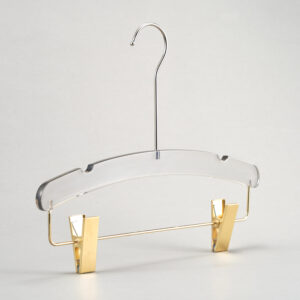
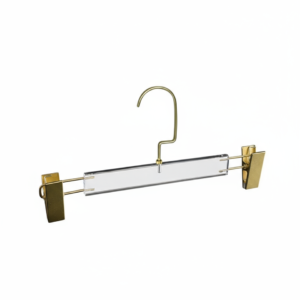
Clip hangers usually hold trousers or skirts at the waistband or another suitable attachment point. The garment hangs vertically, allowing customers to see more of its length and overall silhouette. Many designs use two clips, although clip construction, spacing and garment-contact surfaces vary by model.
Trouser bar hangers support garments folded over a horizontal bar. The fabric remains in position through its weight, the bar’s surface characteristics and the way the garment is balanced. Some specialised designs include locking or clamping mechanisms, but these should not be confused with an ordinary fixed trouser bar.
Neither design guarantees that garments will remain completely free of marks, creases or movement.
Clip Hangers vs. Trouser Bars at a Glance
| Comparison | Pants Hangers with Clips | Trouser Bar Hangers |
|---|---|---|
| Holding method | Clips grip selected points on the garment | Fabric rests folded over a horizontal bar |
| Presentation | Usually allows full-length display | Usually presents garments in a folded arrangement |
| Main advantages | Visible garment shape and adjustable positioning on some models | Compact presentation and the option to hang trousers with a matching jacket |
| Potential issues | Clip marks, slipping or unsuitable contact pressure | Fold lines, slipping or unwanted fabric compression |
| Space requirements | Generally needs more vertical clearance | Often needs less vertical clearance |
| Key sample checks | Clip grip, spacing, contact surface and garment marks | Bar shape, surface grip, fold position and garment balance |
| Common applications | Trousers, skirts, shorts and full-length displays | Trousers, suits, uniforms and coordinated outfits |
These differences provide a starting point, not a universal ranking.
For example, a clip hanger may provide a cleaner full-length presentation but still be unsuitable if its clips mark a sensitive fabric. A bar hanger may save space but create an unwanted fold line on a particular garment.
The appropriate design depends on the clothing and the intended display conditions.
Examples of the Two Structures
Lelvion offers several hanger designs that illustrate these differences.
The S703 rubber-coated clip hanger is intended for trousers, skirts and shorts. Its clips can be repositioned to accommodate different garment widths.
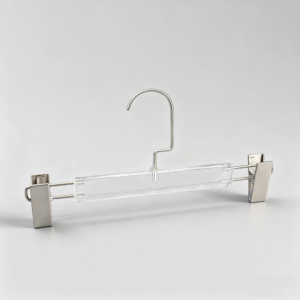
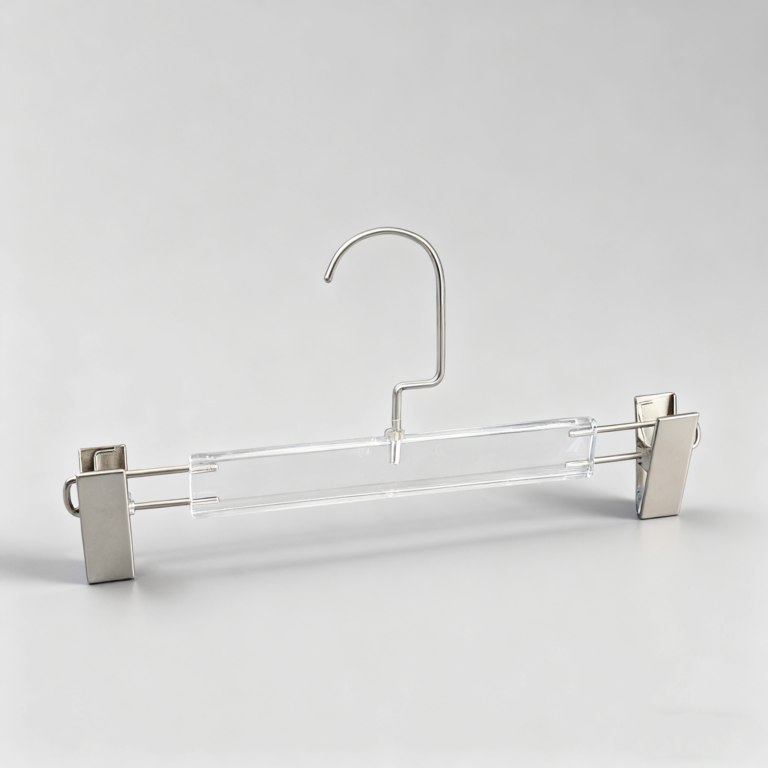
The T110S clear plastic clip hanger provides another clip-style option, with a transparent body and silver-tone hardware.
For folded presentation, the S4010 rubberized suit hanger includes a lower trouser bar, allowing trousers to be displayed or stored with a jacket or shirt.
These are examples of different hanger structures, not comparative performance ratings. Buyers should confirm the actual clip configuration, dimensions and garment compatibility of the selected model.
Which Hanger Is Suitable for Different Garments?
The garment’s construction is usually more important than a general preference for clips or bars.
A retail buyer should consider the garment’s waist construction, fabric behaviour, length, weight distribution and required presentation.
Tailored Trousers and Suit Pants
Tailored trousers can be displayed using either design.
Clip hangers may be appropriate when the retailer wants customers to see the full trouser length, leg shape and overall cut without unfolding the garment.
However, the attachment points must be checked carefully. Some fabrics may show pressure marks where clips contact the waistband or hem.
Trouser bars can be useful when trousers are presented with matching suit jackets or when the display requires a folded arrangement.
The fold position should follow the garment’s construction and intended presentation. Buyers should inspect whether the bar creates a visible line that remains after the trousers are removed.
For tailored products, test both methods before selecting a standard hanger.
Skirts and Shorts
Clip hangers are commonly used for skirts and shorts because they can hold the waistband while leaving the garment body visible.
This can be useful for displaying garment length, pleats, panels and details around the hem.
However, clip placement matters. A narrow waistband, decorative trim or delicate fabric may not tolerate the same contact pressure as a structured waistband.
Buyers should also consider how the garment hangs between the two clips. An unsuitable clip distance may distort the presentation or create tension in the fabric.
A clip hanger is often a practical starting choice, but its suitability still needs to be confirmed with garment samples.
Denim and Casual Trousers
Denim and other structured casual trousers may work with either design.
Clip hangers can display the full trouser shape and keep details such as pockets, stitching and leg cuts visible.
Bar hangers can create a more compact arrangement, particularly where full-length display is unnecessary.
Fabric thickness alone does not establish whether clips will perform better. Buyers should consider the garment’s actual weight, clip-contact area, grip and the likelihood of movement during customer handling.
Where a retailer carries several denim styles, test representative garments rather than relying on a single sample.
Knitwear and Stretch Fabrics
Knitted and stretch fabrics require particular care because their shape may change depending on where the weight is supported.
Clip pressure can affect the appearance of certain fabrics, while folding over a bar may create lines or concentrated support areas.
There is no universal rule that a trouser bar is always safer for knitwear.
Evaluate the garment after hanging, removing and handling it. Check whether the original shape is maintained and whether contact marks remain visible.
The aim is to identify a display method that works with the specific garment construction, not to select a hanger based only on the material name.
Fabric Risks: Clip Marks, Fold Lines and Slipping
Both hanger types can create problems when their contact surfaces or holding methods do not match the garment.
Understanding these risks helps buyers define what should be checked during sample evaluation.
Can Clip Hangers Leave Marks?
Yes. Clip hangers apply localised pressure to the garment.
Depending on the fabric, clip design and duration of use, that pressure may leave a temporary impression or a more persistent mark.
The result can be influenced by several factors:
- The shape and contact area of the clips.
- The condition and texture of the contact surfaces.
- The pressure applied by the clip mechanism.
- The garment’s fabric and construction.
- The clip placement and the way the garment’s weight is distributed.
Buyers should not assume that every clip hanger includes rubber, silicone or another soft contact pad.
Even where pads are present, their suitability should be evaluated with the intended garments.
To assess potential marking, attach a representative garment, observe it while hanging, then remove it and inspect the contact points.
If marks are unacceptable, try an alternative clip design or attachment position where appropriate. Do not assume that adding more grip will solve every problem.
Can Trouser Bars Create Creases?
Yes. Folding fabric over a horizontal bar can create a visible line, particularly where the fold is concentrated over a narrow or unsuitable contact surface.
Bar shape, surface texture, garment construction and fold position can all influence the result.
Some bar designs use coatings or specialised surfaces to improve grip. However, a coating should not be treated as proof that a hanger will prevent creases.
Buyers should check whether trousers remain balanced on the bar and whether the resulting fold is acceptable for the intended display.
If a particular style needs a full-length presentation without a fold, a clip hanger may be the more suitable option, provided the attachment points do not cause other problems.
What About Garments Slipping?
Clip hangers can lose their hold if the contact arrangement is unsuitable for the garment. Bar hangers may allow fabric to slide if the garment is poorly balanced or the surface does not provide sufficient grip.
These are different risks and should be assessed separately.
A practical evaluation includes placing garments on the hangers, moving them during normal handling and checking whether they remain in the intended position.
Inspect the hanger and garment afterwards rather than relying solely on how securely the item appears to hang at first.
Retail Display Space: Full-Length vs. Folded Presentation
Space is another important consideration when purchasing hangers for retail stores.
A full-length display allows customers to see the shape and length of trousers or skirts without unfolding them. This can be useful where garment cut, drape or visible detailing is an important part of the presentation.
The trade-off is vertical clearance.
A trouser or long skirt suspended from clips may extend considerably below the hanger. Buyers must ensure that garments do not touch lower shelves, fixtures, stock or the floor.
Folded presentation on a trouser bar generally reduces the hanging length, making it useful in layouts with limited vertical space.
But saving height does not automatically mean that more garments can be displayed effectively. Rack spacing, garment bulk, hanger profile and customer access still matter.
How to Evaluate Fixture Space
Before deciding on the hanger type:
- Measure the available vertical clearance beneath the rail.
- Hang the longest representative garment using clips and check its lowest point.
- Fold a comparable garment over a trouser bar and check the resulting hanging length.
- Allow for the movement needed when customers and staff remove or replace garments.
- Review how closely garments can be arranged without obscuring the display or causing excessive contact.
These practical checks are more useful than applying a universal garment-per-rail figure.
Presentation Consistency Across Stores
Retail chains may also need to standardise hanger appearance across several locations.
A consistent hanger finish, hook style and garment presentation can help stores follow the same visual merchandising plan.
However, consistency should not require every garment to use the same structure.
For example, a retailer might choose coordinated finishes across both clip hangers and suit hangers with trouser bars. This maintains a common appearance while allowing different garment types to use suitable holding methods.
The purchasing specification should therefore distinguish between visual consistency and functional requirements.
Decision Matrix: Choosing Between Clips and Bars
The following matrix gives apparel buyers a practical starting point.
It is not a substitute for testing actual garments. Each recommendation should be checked against the product’s construction and intended display conditions.
| Garment Type | Display Requirement | Initial Hanger Choice | What to Verify |
|---|---|---|---|
| Tailored trousers | Show the full leg and silhouette | Clip hanger | Clip contact marks, waistband support and overall drape |
| Suit trousers | Keep trousers with a matching jacket | Suit hanger with trouser bar | Fold position, balance and garment clearance |
| Skirts | Display the full skirt shape | Clip hanger | Clip spacing, fabric marks and waistband stability |
| Denim | Full-length casualwear presentation | Clip hanger | Holding grip, contact pressure and handling stability |
| Casual trousers | Compact folded presentation | Trouser bar hanger | Slipping, fold lines and rail space |
| Delicate fabrics | Avoid unacceptable contact marks | Compare both designs | Fabric response at clip and fold contact points |
| Stretch trousers | Maintain the intended garment shape | Compare both designs | Shape change, support points and recovery after removal |
| Coordinated uniforms | Keep upper and lower garments together | Suit hanger with trouser bar | Combined garment fit and ease of handling |
The matrix should be used alongside the retailer’s own garment samples.
For some styles, either hanger type may be acceptable. The final choice may then depend on visual presentation, standardisation across stores or handling efficiency.
How to Make the Final Choice
A useful approach is to separate the decision into three questions.
First, what must the customer see? If full garment length is essential, clips may be more appropriate. If the item is usually shown as part of a coordinated set, a bar may be preferable.
Second, how does the garment react to the hanger? Test whether contact pressure, folding or movement changes its appearance.
Third, what does the store layout allow? Confirm rail height, garment spacing and access for customers and staff.
A hanger should meet all three requirements before it becomes the standard for a product range.
Bulk Buying Checklist: What to Check Before Ordering
Selecting the preferred structure is only the first stage of a wholesale hanger purchase.
Buyers also need to confirm that the chosen model, materials, components and packaging will work for the intended retail programme.
The following checklist separates sample evaluation from request-for-quotation specifications.
A. Sample Evaluation Checklist
Before committing to a bulk order, evaluate representative hanger samples with the actual garments to be displayed.
1. Garment fit
Confirm that the hanger width, clip spacing or bar dimensions suit the garment. Test different garment sizes if the range varies significantly.
2. Clip holding performance
For clip hangers, check that the clips can be opened and positioned conveniently and that the garment remains securely attached during normal handling.
3. Fabric contact
Inspect the garment where clips or bars touch the fabric. Look for unwanted impressions, creases, surface changes or signs of slipping.
4. Bar performance
For bar hangers, check whether the folded garment stays balanced and whether the fold location is acceptable.
5. Hook and component fit
Check that the hook fits the intended rail and that the hanger can be removed and replaced without unnecessary difficulty.
6. Hardware and surface finish
Inspect accessible contact areas for rough edges or other features that might catch on fabric. Confirm the actual finish and component configuration supplied with the sample.
7. Repeated handling
Simulate normal merchandising activity, including removing garments, returning them to the rail and repositioning the hangers.
8. Packaging suitability
Review how the hangers are packed and whether the proposed cartons and protective materials are appropriate for handling and transport.
Record the observations against the specific sample and model. Where a result is unsatisfactory, describe the problem to the supplier and request a suitable alternative or adjustment.
There is no single testing duration, clip force or hanger dimension that establishes suitability for every garment. The evaluation method should reflect the retailer’s actual products and requirements.
B. RFQ Specifications for Wholesale Hangers
A complete request for quotation helps suppliers identify suitable existing models and assess whether customization is necessary.
| RFQ Field | Information to Provide |
|---|---|
| Hanger type | Clip hanger, trouser bar hanger or both |
| Garment application | Trousers, skirts, suits, uniforms or other garments |
| Reference | Existing model, product link, photograph, sample or drawing |
| Dimensions | Required hanger width, clip spacing, bar dimensions and relevant hook measurements |
| Material | Preferred wood, plastic or coated construction |
| Surface and hardware | Required finish, component appearance and garment-contact details |
| Color and branding | Hanger colors, logo artwork, placement and other branding needs |
| Order quantity | Estimated initial volume and any repeat-order requirements |
| Packaging | Pieces per carton, carton requirements, labels and shipping marks |
| Destination | Delivery country, destination or requested delivery terms |
| Sampling | Whether approval samples are needed before bulk production |
Not every project requires a custom hanger.
A buyer may find that an existing model meets the garment and display requirements with no structural changes. Others may need modifications to color, logo, components or packaging.
If the required shape or construction cannot be produced with an available model, new tooling may need to be evaluated.
The difference matters because customization requirements can affect quotation details, minimum order quantities, sampling and production arrangements.
Lelvion offers OEM hanger manufacturing and customization services for projects based on existing models or new design requirements. Available options depend on the selected product and the proposed order.
Relevant Lelvion Hanger Options
Buyers comparing the two holding methods can begin with the following product examples:
- S703 Rubber-Coated Clip Hanger — for trousers, skirts and shorts displayed using clips.
- T110S Clear Plastic Clip Hanger — a transparent clip-style option with silver-tone hardware.
- W703S Wooden Clip Hanger — a wooden option for hanging trousers and skirts.
- S4010 Rubberized Suit Hanger with Bar — for folded trousers and coordinated garments.
- 4010W Plastic Hanger with Trouser Bar — a PP plastic option with a lower bar.
These models represent different materials and structural approaches. They are not interchangeable without evaluating garment fit.
Buyers can also browse the full Lelvion hanger range to compare other available designs.
Frequently Asked Questions
Can pants hangers with clips leave marks on trousers?
Yes. Clips apply pressure at their contact points, which may create visible marks on certain fabrics. The result depends on the garment, clip construction and how it is used. Test the intended garments and inspect the fabric after removing the clips.
Are trouser bar hangers better for suit pants?
They can be useful when suit trousers are folded and displayed with a matching jacket. However, the fold may create an unwanted line on some fabrics. A clip hanger may be preferable when full-length presentation is important, provided the garment can be held without unacceptable marking.
Can clip hangers be used for skirts and heavier trousers?
Clip hangers are commonly used for skirts and trousers, including some heavier garments. Suitability depends on the specific clips, garment construction and weight. Check that the clips hold securely and that the contact points do not cause unacceptable marks. Do not assume a universal minimum hanger width or holding force.
Which hanger uses less vertical retail display space?
A trouser bar hanger often requires less vertical clearance because the garment is folded over the bar. A clip hanger generally needs more clearance when it displays the garment at full length. Measure the actual garments on the intended fixtures before deciding.
Do clip hangers always have non-slip pads?
No. Clip construction and contact surfaces vary between products. Buyers should confirm whether pads are present, what materials contact the garment and which configurations are available for the selected model.
What should retail buyers test before ordering hangers in bulk?
Test garment fit, holding performance, contact marks, folding behaviour, hook compatibility, component finish and routine handling. Use representative garments and record the results against the exact sample configuration.
What information should I include in a pants hanger RFQ?
Include the preferred hanger type, garment application, dimensions, material, quantity, color, hardware requirements, any logo or packaging needs, and delivery destination. Reference photos, drawings or existing product links can help clarify the request.
Final Recommendation for Retail Buyers
The best hanger is the one that supports the garment’s intended presentation without creating unacceptable fit, handling or fabric-contact problems.
Choose clip hangers as a starting point when full-length display matters. Consider trouser bar hangers when folded presentation, coordinated outfits or reduced vertical clearance are priorities.
Before standardising either design across a retail programme, compare samples using the actual garments and fixtures involved.
For wholesale sourcing, review the available Lelvion hanger models and prepare a clear specification covering structure, material, dimensions, quantity and any customization requirements.
If you need help comparing clip hangers with trouser bar designs, contact Lelvion for a quotation with your garment requirements, reference model and estimated order quantity.