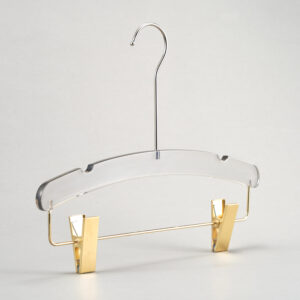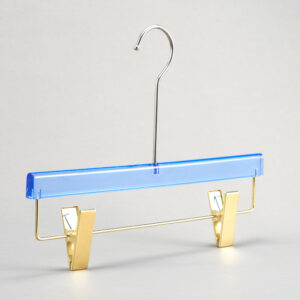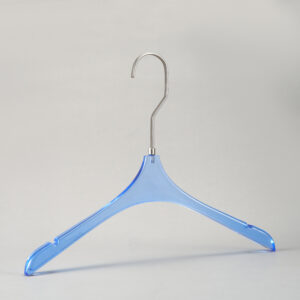

A common adult hanger-size reference is 16 to 17 inches (40.6 to 43.2 cm), but there is no single standard hanger size for every garment. Hangers.com’s retail buying guide suggests that length range for standard women’s garments and 17 inches (43.2 cm) for standard men’s garments. These are retail suggestions, not a universal specification. The right choice also depends on the garment’s shoulder shape, neckline and intended presentation.
Reference sizes in inches and centimeters
A hanger size chart is a starting point for comparison. The adult examples above come from a retailer’s “Suggested Hanger Length” guidance; they do not define overall-width measurement points or determine fit for every clothing size. Smaller garments need separate assessment rather than an automatic adult-size choice.
For a specification-based example, the GS1 US Voluntary Guidelines for Hanger Specifications for Floor Ready Merchandise, Release 7.0, dated March 27, 2017, lists the following overall widths for particular profiles:
| GS1 2017 profile group | Listed overall-width examples, inches | Converted examples, cm |
|---|---|---|
| Metal-hook top hangers | 10, 12, 15, 17, 19 | 25.4, 30.5, 38.1, 43.2, 48.3 |
| Plastic-hook top hangers | 10, 12, 15, 17 | 25.4, 30.5, 38.1, 43.2 |
| Bottom hangers | 8, 10, 12, 14 | 20.3, 25.4, 30.5, 35.6 |
The GS1 figures belong to that 2017 US floor-ready guideline, which checks dimensions against approved full-scale profile drawings. They are not Lelvion product specifications. A retailer program may have its own current requirements, so use the relevant program document for an order.
One inch equals 2.54 cm or 25.4 mm. For example, 17 inches is 43.18 cm, shown here as 43.2 cm after rounding. A rounded conversion should not become a second acceptance dimension: select one controlling unit for the specification and agree any permitted variation for the model.
How to measure a hanger for an order
A number such as “43 cm” is useful only when both parties know where it starts and ends. Show the finished hanger from the front and side on the dimension sheet, with arrows marking each relevant measurement.
For an overall-width comparison, mark the outer ends. Keep that dimension separate from shoulder support depth, overall height and hook opening. A trouser bar needs a usable span; clip positions need a spacing measurement. A front view and side view help distinguish these dimensions when a product description uses an ambiguous label such as “shoulder width.”
For an end-to-end width check, place the hanger in the same orientation as the agreed front-view drawing and measure the straight distance between the marked outer points. Following the curved shoulder with a tape would measure a different distance. Record whether the drawing includes the hook and fittings or describes the body alone.
Match the profile to the garment
Shirts, dresses and smaller garments
For shirts and lightweight tops, look at where the hanger ends sit inside the shoulder. Note any protrusion into the sleeve, unsupported area or visible distortion. Test the smallest and largest relevant garments as well as a middle size.
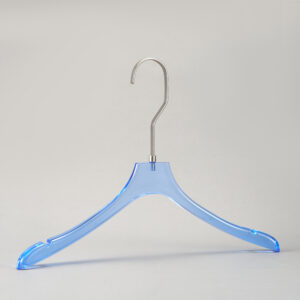
A wide-neck dress may need a different profile from a conventional shirt. If it slips during normal handling, observe where the movement begins. A notch helps only when the strap sits in it; surface grip should be evaluated after checking whether the shape supports the garment properly.
For knitwear-specific decisions, see the jumpers, sweaters and knitwear guide.
Children’s and smaller garments need their own samples. A children’s size label or an adult chart cannot establish the correct width for every cut. Several size groups may need different hanger models.
Jackets, coats and coordinated sets
View a structured jacket from the front and side. The shoulder should retain the intended silhouette without visible pressure points at the hanger ends. A broader support surface may be worth trying, but shoulder slope and contour also affect the result.
For coats, include garment balance, fixture compatibility and the loaded sample in the assessment. A “heavy-duty” label does not establish a numerical load capacity. Where capacity matters, agree the requirement and supporting test evidence separately.
A coordinated set needs a combined trial. The jacket may fit well while the trousers shift on the bar or the loaded set becomes awkward to handle. Judge the complete outfit as store staff will use it.
Trousers and skirts
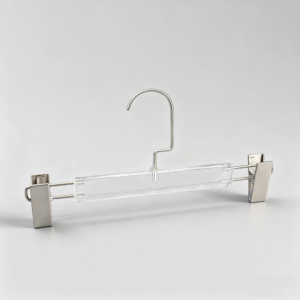
Choose between folded presentation over a bar and hanging from the waistband. For a bar, inspect the fold and whether the garment stays in position during handling. For clips, compare the usable spacing with the actual waistband, check whether adjustment is needed across the size range, and inspect the fabric where each clip contacts it.
A loaded sample shows whether a skirt hangs level and whether the clips suit its waistband. For clear PS model and carton comparisons after selecting the required configuration, use the Clear Plastic Hangers wholesale guide.
Check grip and the store fixture
Once the profile fits, compare how the fabric behaves on the proposed surface. If a garment still slips, a different surface, notch or retention feature can be evaluated with that garment. Avoid treating a higher-grip finish as a substitute for a suitable support shape.
The hook also needs to fit the rail. Use the intended fixture, or an equivalent sample, to assess hook opening and clearance. Confirm the hook type, orientation and finish for the selected model, and include the agreed configuration in the order specification.
Rack density is a separate display decision. The garment hanger spacing guide addresses that topic; hanger body dimensions alone do not determine the space needed for a loaded garment.
Run a repeatable garment sample check
Use the same visual and handling check for each candidate so that the comparison is repeatable. This is a fit assessment; load capacity and durability require separate evidence.
- Load the garment as store staff normally would, without arranging it unusually carefully to make the hanger look suitable.
- Inspect both shoulders and the neckline. Record visible protrusion, loss of support, imbalance or distortion.
- Lift the hanger, place it on the rail, slide it and return it. Note whether the garment moves out of position and where the movement starts.
- View the garment from a normal display distance as well as close up. Compare its appearance with the intended retail presentation.
- Repeat with difficult garments, including extreme sizes, wide necklines, structured shoulders or fabrics that slipped on other samples.
Keep photos and observations against the garment reference and hanger model, including which sizes were assessed.
Keep a usable specification for repeat orders
Record the selected model, body material, dimensioned profile, finish and hook configuration alongside the garment category and sizes tested. Include the bar or clip arrangement where relevant, logo details and the approved sample reference. Photos of the loaded sample help a new buyer understand the fit decision.
Several garments can share a hanger when the samples support that choice. Shirts, structured jackets and skirts may still need different configurations. Review the earlier fit decision when the apparel range changes instead of assuming the previous model will suit the new collection.
Prepare an inquiry around the garment
A useful inquiry includes garment categories and size range, representative photos, relevant garment dimensions, an existing hanger reference if available, and the intended fixture. Add the requested surface, hardware, branding and order quantity. Identify any dimensions that still need definition so the supplier can respond to the same specification.
Explore Lelvion’s OEM options, or send your garment specifications and quantity requirements through our contact page.