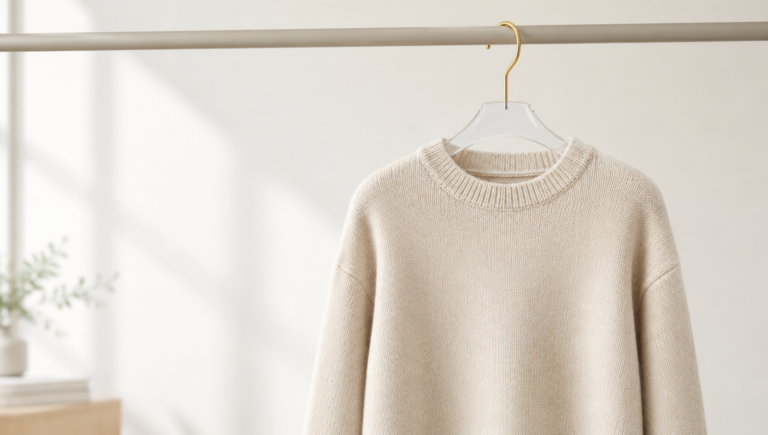
Choosing a hanger for a shirt is usually straightforward. Choosing one for a jumper is not.
Knitwear behaves differently from woven garments. A lightweight cotton jumper, a fine merino cardigan and a heavy loose-knit sweater can all react very differently when placed on the same hanger. The shoulder shape, garment weight, neckline and knit structure all affect whether hanging is practical and what kind of hanger should be used.
This is why there is no single “best hanger for jumpers” that works in every situation.
Heavy or loosely knitted sweaters are often better folded, especially when they will remain in storage for a long time. In retail stores, showrooms and apparel presentation, however, jumpers and other knitwear frequently need to be hung. In those situations, buyers should look beyond simple material labels such as plastic, wood or velvet.
The shape of the shoulder, the width of the hanger, the amount of surface grip and the weight of the garment often matter more than the material name alone.
For retailers, apparel brands and garment suppliers sourcing hangers in volume, that distinction is important. A hanger should be selected for the garment it needs to support, not simply because one material is commonly described as more premium than another.
Should Sweaters and Jumpers Be Hung or Folded?
The first question is not which hanger to buy. It is whether the garment should be hanging in the first place.
Heavy jumpers can gradually stretch under their own weight. This is especially true for loose knits, open weaves and garments made from soft yarns that have little structural resistance. When these garments stay on a hanger for long periods, gravity can pull the fabric downward and place unnecessary stress around the shoulder area.
For long-term storage, folding is often the safer choice for this type of knitwear.
That does not mean jumpers should never be hung.
Retailers need garments visible on a sales floor. Showrooms need samples displayed clearly. Fashion brands may keep knitwear on rails during fitting, photography, merchandising or order presentations. Warehouses may also hang selected garments for short-term handling.
In these situations, the hanger needs to work with the garment rather than against it.
A lightweight structured jumper can normally tolerate hanging more easily than a heavy loose-knit sweater. A cardigan may need more surface grip because the open front and wider neckline can make it easier to slip from a smooth hanger. A knitted jacket may need a wider and more rounded shoulder profile because the garment itself has more structure.
The practical rule is simple.
If a jumper does not need to be hung, folding may be the better option. If it does need to be hung, choose the hanger according to the garment’s shoulder shape, weight and surface behaviour.
That approach is much more useful than assuming that one particular hanger material is always best for sweaters and jumpers.
What Makes a Good Hanger for Sweaters and Knitwear?
When we look at hangers from a manufacturing point of view, four areas deserve particular attention for knitwear.
Shoulder width, shoulder shape, surface grip and garment weight.
They are closely connected. Changing one can affect how the garment sits on the hanger.
Shoulder Width
A hanger that is noticeably narrower than the garment shoulder concentrates more of the garment weight into a smaller area.
For shirts this may not be a major problem. For some jumpers, particularly heavier styles, it can create a poor fit around the shoulder.
Going too wide is not the answer either.
If the ends of the hanger extend too far into the sleeves, the garment can be pushed outward at the wrong position. A buyer should therefore avoid treating “wider” as automatically “better”.
The hanger should correspond reasonably well with the actual shoulder span of the garment.
This is one reason we normally recommend testing an actual garment rather than selecting a bulk hanger order only from a photograph or catalogue specification.
A difference that looks small on a specification sheet can become much more noticeable once a jumper is placed on the hanger.
Shoulder Shape and Contour
Shoulder width tells only part of the story.
Two hangers can have similar overall dimensions and still support a garment differently because their shoulder profiles are different.
A narrow, flat hanger creates a different contact area from a broader hanger with a rounded shoulder. For garments that need more support across the shoulder, the shape of the hanger can therefore be just as important as its total length.
This matters when sourcing hangers for structured jumpers, knitted jackets and knitwear intended for retail presentation.
A broader profile can spread contact across a larger area, while a rounded shoulder end can create a smoother transition between the hanger and the garment.
The important point is not to claim that every jumper requires a wide-shoulder hanger. Some lightweight jumpers do not.
The question is whether the shoulder profile matches the garment being displayed.
Surface Grip
Surface grip becomes important when the main problem is not support, but slipping.
Some jumpers have relatively wide necklines. Cardigans can sit differently because of their open front. Lightweight knitted tops may move easily on a smooth hanger surface.
In these cases, a rubber coated or other non-slip surface can help the garment remain in position during display and handling.
This is particularly relevant in retail environments.
A garment that repeatedly slides toward one side of the hanger does not present well on a rail. Staff then have to reposition it, and the display becomes inconsistent.
For this reason, buyers looking for hangers for jumpers should ask a simple question before focusing on hanger material:
Is the main problem shoulder support, or is the main problem garment slippage?
The answer can point toward a very different hanger design.
Garment Weight
A lightweight jumper and a heavy winter sweater should not automatically use the same hanger.
Garment weight affects how much pressure is transferred to the shoulder contact points. It also affects how easily a hanger may flex and how important shoulder shape becomes.
Lightweight knit tops may benefit more from surface grip than from a very broad shoulder.
Medium-weight jumpers may need a balance between grip and shoulder support.
Heavy or loose-knit sweaters may be better folded rather than hung for extended periods.
This is why we would not recommend choosing a hanger for knitwear based only on a product photo.
The garment itself should be part of the hanger selection process.
Rubber Coated vs Wide-Shoulder Hangers: Which Matters More?
This is one of the more useful distinctions for buyers sourcing hangers for sweaters and jumpers.
Rubber coated and wide-shoulder designs solve different problems.
A rubber coated hanger is mainly useful when the garment tends to move, slide or sit unevenly on a smooth hanger.
A wide-shoulder hanger is mainly useful when the buyer wants a broader contact area and a different shoulder profile.
Neither feature is automatically more important.
Imagine a lightweight jumper with a wide neckline. The garment itself may not require a particularly heavy shoulder structure, but it may slide easily. In that case, additional surface grip can be more useful.
Now consider a more structured knitted garment with a defined shoulder. Slipping may not be a serious issue, but a narrow hanger may not support the shoulder area in the way the retailer wants. A broader shoulder profile may therefore be more relevant.
There are also garments where both factors matter.
This is why material-based comparisons can be misleading.
Statements such as “wood is best for sweaters” or “plastic hangers are unsuitable for jumpers” are too general to be useful for professional sourcing.
Plastic hanger designs vary enormously.
A narrow commodity hanger and a broad, contoured plastic hanger are both technically plastic hangers, but they do not support a garment in the same way.
The same applies to wood, flocked hangers and metal hangers.
The correct comparison should be between actual hanger structures rather than simply between material categories.
Three Hanger Designs to Consider for Sweaters and Jumpers
For buyers comparing hangers for jumpers, the following three Lelvion models represent three slightly different approaches.
They should not be treated as interchangeable. Each one is worth considering for a different reason.
S2017 Rubber Coated Hanger: When Grip Matters
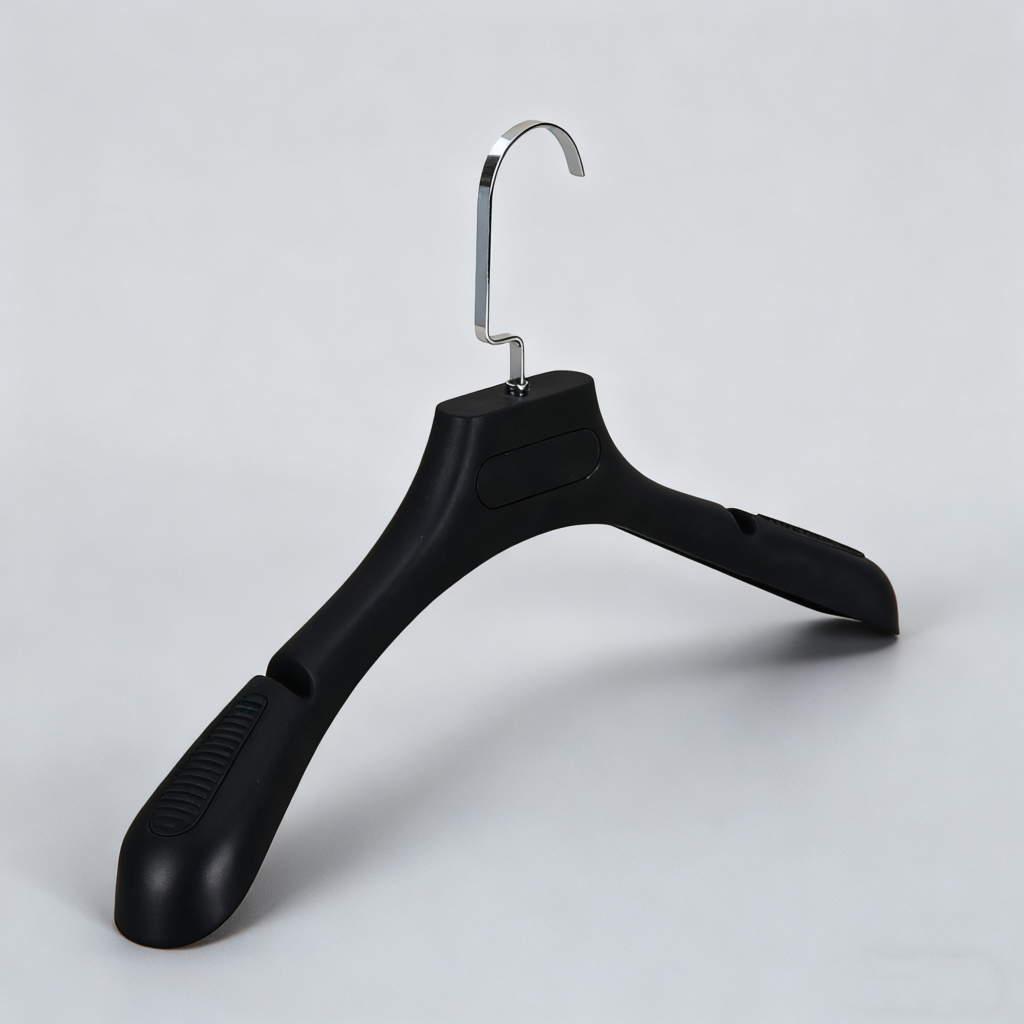
The S2017 Rubber Coated Hanger is the most direct option of the three when garment slippage is the main concern.
It is a 39.5 cm ABS hanger with a rubber coated non-slip surface.
The important feature here is not simply the material. It is the surface behaviour.
For lightweight to medium-weight jumpers, knit tops and cardigans that tend to move on a smooth hanger, the rubberized finish can provide additional grip.
This can be useful for retail rails where garments are handled regularly and need to remain visually consistent.
It can also make sense for jumpers with wider necklines or lighter knitted constructions that do not sit securely on a conventional smooth plastic hanger.
S2017 has a relatively simple upper-garment format. There is no trouser bar or clip structure occupying the lower section of the hanger.
That makes it visually straightforward for tops and knitwear.
For buyers searching specifically for non-slip hangers for sweaters or rubber coated hangers for jumpers, this is the first of the three models we would normally suggest comparing.
It is still important to test the actual garment.
A heavy loose-knit sweater may not be suitable for hanging at all, regardless of whether the hanger surface is non-slip. On the other hand, for a lighter jumper where the main problem is movement rather than weight, surface grip may be exactly the feature that matters.
T31 Rounded Wide-Shoulder Hanger: When Shoulder Shape Matters
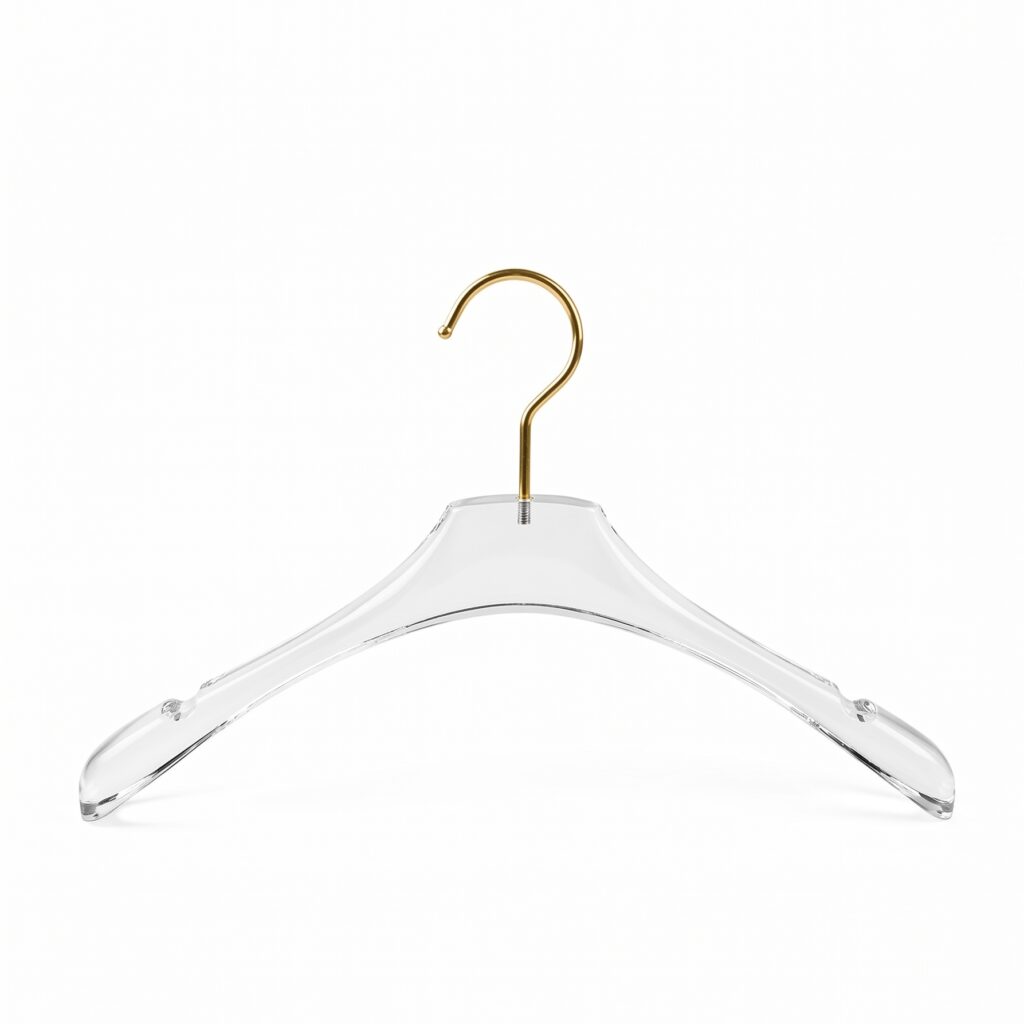
The T31 Crystal Clear Hanger approaches the problem differently.
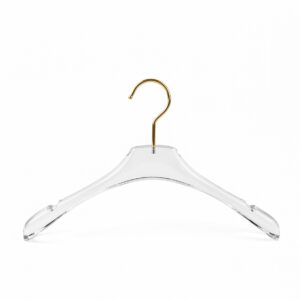
T31 is a 39 cm transparent PS hanger with a 3.0 cm rounded wide-shoulder profile.
For this model, the key feature in the context of jumpers is the shoulder geometry.
Rather than focusing mainly on grip, T31 provides a broader and more rounded shoulder area.
That makes it a model worth testing when the garment has more structure around the shoulder or when the buyer wants to compare a broader support profile against a narrow standard hanger.
This can be relevant for some structured knitwear, heavier knitted tops and retail garments where shoulder presentation matters.
The rounded end is also important.
Shoulder support should not be judged only by the numerical width of the hanger. How the outer shoulder area is shaped affects how the garment rests on it.
T31 therefore makes sense as a comparison option for buyers looking at wide-shoulder hangers for sweaters or jumpers.
Its transparent appearance can also suit retail environments where the hanger is intended to remain visually understated and allow more attention to stay on the garment.
That visual point should remain secondary to garment fit.
For knitwear, the first test should still be whether the shoulder profile actually suits the garment.
T30 Wide-Shoulder Hanger: A More Conventional Broad Profile
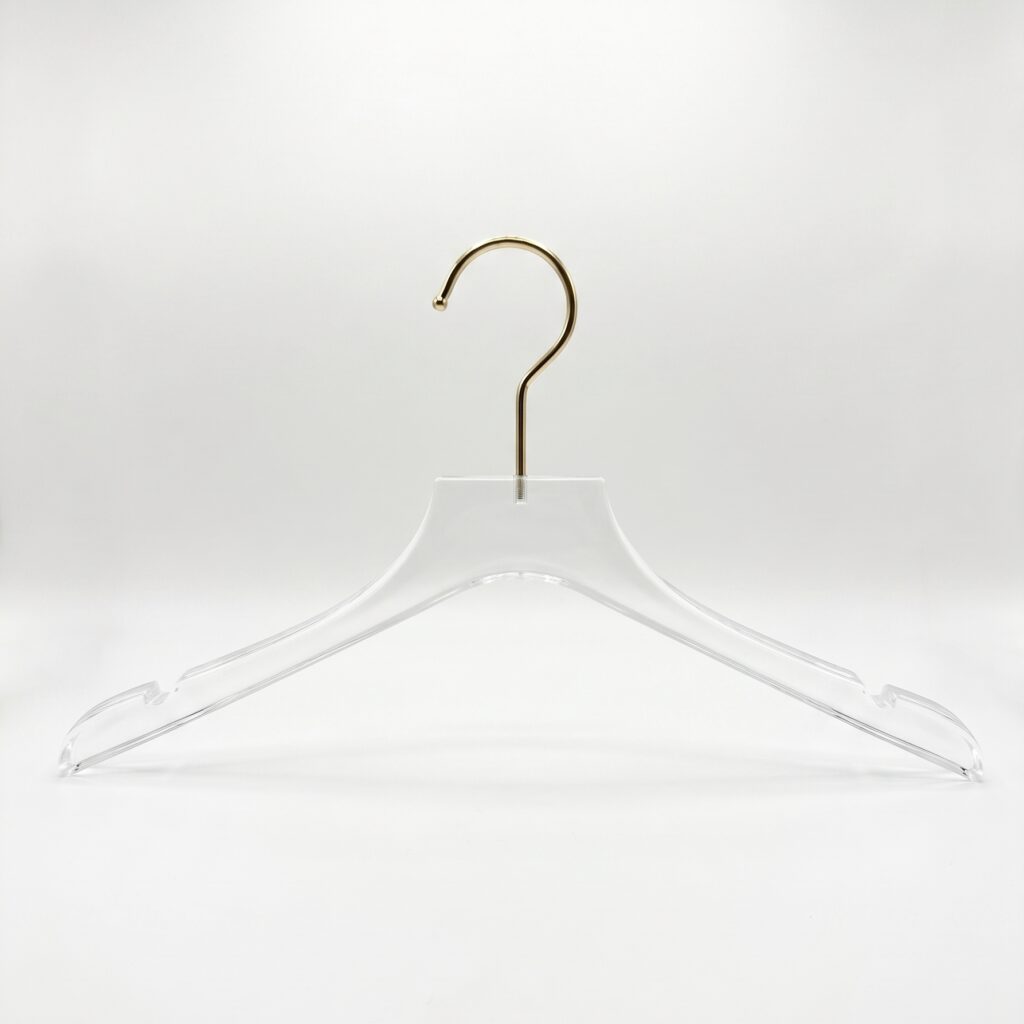
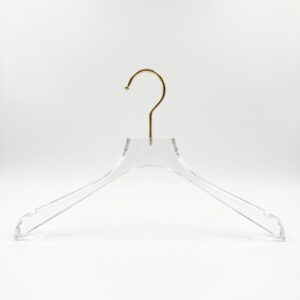
The T30 Crystal Clear Hanger is another transparent PS model with a broad 3.0 cm shoulder.
Its overall length is 39.5 cm.
T30 and T31 may look similar at first glance because both use a wider shoulder structure, but buyers should not assume that similar dimensions mean identical garment fit.
T30 has a more conventional broad-shoulder profile, while T31 places greater emphasis on a rounded outer shoulder shape.
For a sourcing project involving jumpers, structured tops or other knitwear, these two models are therefore useful to compare with the actual garment.
In many cases the difference between two hanger profiles becomes much easier to see once the garment is hanging on them.
One may align more naturally with the shoulder line.
Another may extend slightly farther into the sleeve.
One may produce a cleaner retail presentation for a particular garment pattern.
These differences are difficult to judge from hanger specifications alone.
For that reason, we see T30 less as a universal “sweater hanger” and more as a broad-shoulder option that should be tested against the garment and compared with alternatives such as T31.
That is a more realistic way to source hangers for jumpers in volume.
S2017 vs T31 vs T30: Which Hanger Should Buyers Test?
The three models answer different sourcing questions.
S2017 should be considered first when the buyer’s concern is slipping.
If lightweight jumpers, cardigans or knit tops move too easily on conventional smooth hangers, the rubber coated non-slip surface is the main reason to test S2017.
T31 should be considered when shoulder shape is the main concern.
Its 3.0 cm rounded wide-shoulder design gives buyers a different support profile to compare with standard narrow hangers.
T30 should be considered when the buyer wants a broad shoulder but prefers to test a more conventional profile alongside T31.
There is no need to force one model into every knitwear application.
For a retailer handling several different jumper styles, it may even make sense to test more than one hanger profile.
A thin knitted top may work better on S2017.
A more structured jumper may look better on T31.
Another garment may sit naturally on T30.
The correct answer comes from the garment, not from the product name.
This is especially important for brands developing a standard hanger program across several clothing collections. A hanger that works well for one style may not be ideal for another.
The goal is usually not to find the theoretically strongest hanger.
The goal is to find a hanger that supports the garment correctly, presents it well and can be supplied consistently in the required volume.
How Retailers Should Test Hangers for Knitwear Before Ordering
For bulk hanger sourcing, a simple garment test can reveal more than a long list of theoretical specifications.
Start with the actual jumper or knitwear sample that will be displayed.
Place it on the hanger and look at where the hanger shoulder ends in relation to the garment shoulder.
If the hanger is clearly too narrow, the garment may fall away from the support point too early.
If it extends too far into the sleeve, the hanger may also be too wide for that garment.
Next, look at the outer shoulder area.
The garment should rest naturally rather than being pushed into an unnatural shape.
For wider or more structured hangers such as T30 and T31, this is where comparing the two profiles can be useful.
Then check whether the garment remains centred.
This is particularly important for cardigans, wide-neck jumpers and lightweight knitwear.
If the garment continually moves or slides on a smooth hanger, a rubberized design such as S2017 may be worth testing.
Leave the garment hanging for a reasonable test period.
The purpose is not to simulate years of storage. It is simply to see whether obvious shoulder impressions, slipping or shape changes begin to appear during normal display conditions.
Also look at the hanger on the rail.
Retail hanger selection is not only about the individual garment.
Buyers need to consider how a full row of garments looks together.
Is the hanger profile consistent?
Does the garment sit at the expected height?
Does the shoulder width create the right spacing between garments?
Does the hanger visually compete with the clothing, or does it remain relatively neutral?
For transparent hangers such as T30 and T31, the clear material can help keep the hanger visually discreet in some merchandising environments.
For rubber coated hangers such as S2017, the surface finish may instead contribute to a more controlled and non-slip display.
Different retail concepts will value those characteristics differently.
Testing before placing a larger order is therefore a practical sourcing step, not an unnecessary delay.
What Buyers Should Specify When Sourcing Hangers for Sweaters and Knitwear
A useful hanger enquiry should contain more than a request for “the best hanger for jumpers”.
That description is too broad for a manufacturer to understand the actual application.
Start with the garment type.
Is it a lightweight knitted top, a cardigan, a structured jumper, a knitted jacket or a heavy sweater?
Then provide an approximate garment shoulder width and, where relevant, the approximate garment weight.
If you already have a hanger that works well, provide its dimensions or send photographs.
The intended use also matters.
A hanger for retail display may be selected differently from one intended for warehouse handling or long-term garment storage.
Buyers should also specify whether surface grip is important.
If garments have been slipping from existing hangers, mention this directly. It immediately changes the type of hanger that should be considered.
Shoulder profile should also be discussed.
If the existing hanger is causing problems because it is too narrow, buyers can compare broader profiles. If a particular rounded shoulder shape already works well, supplying a reference sample can make the sourcing process much more efficient.
Other normal hanger specifications still matter.
These include hanger length, colour, hook finish, logo requirements, packaging requirements, order quantity and destination.
For custom hanger projects, these details can be discussed through our OEM hanger service.
The more clearly the garment and application are defined, the easier it is to compare suitable hanger structures before moving into a bulk order.
Common Mistakes When Choosing Hangers for Sweaters and Jumpers
One common mistake is choosing by material alone.
A buyer may begin with the idea that wooden hangers are automatically better for jumpers or that plastic hangers are automatically unsuitable.
That skips the more useful questions.
How wide is the shoulder?
What shape is the shoulder end?
Does the surface provide enough grip?
How heavy is the garment?
How long will it remain hanging?
A well-designed plastic hanger and a poorly matched wooden hanger can produce very different results. Material is part of the specification, but it should not replace proper garment fitting.
Another mistake is choosing the widest hanger available.
More shoulder area can be useful, but only when it matches the garment. An oversized hanger can extend too far into the sleeve and create its own fit problem.
The opposite problem is common as well.
Very narrow hangers may be convenient and space efficient, but they are not automatically suitable for every jumper.
Ignoring surface grip is another frequent issue.
A hanger may have the correct dimensions and still perform poorly if the garment keeps sliding from it.
This is where rubber coated designs become relevant.
The final mistake is ordering a large quantity before testing the hanger with the actual garment.
For standard shirts, buyers can sometimes work confidently from familiar hanger specifications.
Knitwear tends to be less forgiving because fabric structure and garment weight vary so much.
A short comparison between two or three hanger profiles before confirming the final specification can prevent a much larger problem later.
FAQ About Hangers for Sweaters, Jumpers and Knitwear
What are the best hangers for sweaters?
The best hanger depends on the sweater.
Lightweight sweaters that tend to slip may benefit from a non-slip or rubber coated hanger. More structured knitwear may benefit from a broader or more rounded shoulder profile.
Heavy and loose-knit sweaters may be better folded rather than kept on a hanger for long periods.
Instead of choosing by material alone, compare the hanger width, shoulder shape, surface and garment weight.
What are the best hangers for jumpers?
The same principles apply to jumpers.
For lightweight jumpers, surface grip can be important if the garment tends to move on the hanger.
For structured jumpers, shoulder width and contour may become more important.
For heavy jumpers, first consider whether the garment needs to be hanging at all.
When sourcing hangers for jumpers in bulk, it is better to test the actual garment than to rely only on a general hanger category.
Are wide-shoulder hangers better for sweaters and jumpers?
They can be, but not in every case.
A wider shoulder can increase the contact area between the garment and the hanger, which may be useful for certain structured garments.
However, a hanger that is too wide can also extend too far into the sleeve.
The width should therefore be matched to the garment rather than maximised.
Are rubber coated hangers good for knitwear?
Rubber coated hangers can be useful for knitwear when slipping is the main problem.
The added surface grip can help lightweight jumpers, knitted tops and cardigans remain in position during retail display.
The S2017 is an example of this type of hanger.
For heavier garments where shoulder support is the main concern, buyers may also want to compare a broader hanger profile.
Are plastic hangers suitable for sweaters?
Some are and some are not.
“Plastic hanger” describes a material category, not a single hanger design.
A thin narrow plastic hanger and a broad rounded plastic hanger can behave very differently with the same jumper.
For sweaters and knitwear, the relevant factors are shoulder width, profile, surface grip, structural strength and garment weight.
Plastic should therefore not be rejected or selected based on the material name alone.
Should sweaters and jumpers be hung or folded?
Heavy, delicate or loose-knit sweaters are often better folded, particularly for longer-term storage.
Lightweight or structured jumpers can sometimes be hung when an appropriate hanger is used.
Retailers and showrooms may also need to hang knitwear for display even when folding would otherwise be preferred.
In those cases, the hanger should be selected according to the garment rather than using the same hanger for every style.
Choosing a Hanger for a Knitwear Program
For retailers and apparel brands, choosing hangers for jumpers is rarely about finding one universal model.
The practical question is what problem needs to be solved.
If the garment slips, compare a non-slip design such as the S2017 Rubber Coated Hanger.
If shoulder shape and support area are more important, compare a rounded wide-shoulder design such as the T31 with a broader conventional profile such as the T30.
Most importantly, test the hanger with the actual jumper, sweater or knitwear sample before finalising a bulk specification.
Garment type, shoulder width, garment weight and intended use tell us far more than simply asking for a plastic, wooden or velvet hanger.
If you are sourcing hangers for sweaters, jumpers, cardigans or other knitwear, send us the garment type, approximate shoulder width, required quantity and intended use through our contact page. We can then compare the relevant hanger profiles before the specification is confirmed.