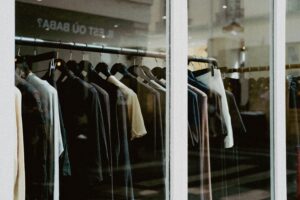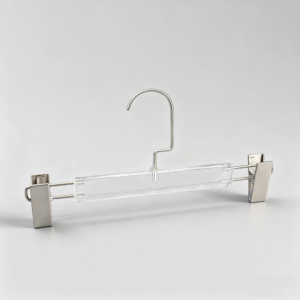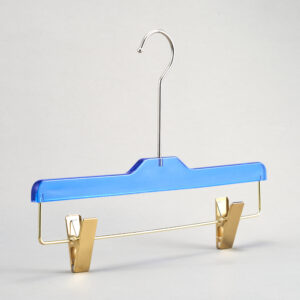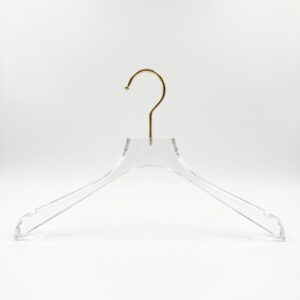
A hanger can change how a garment sits, how densely a rail is filled and how consistent the display looks.
That does not mean a hanger can be assigned a universal percentage increase in perceived value or sales. Those effects depend on the product, store, customer and many other variables.
The useful approach is to focus on what can actually be observed and controlled.
Start With the Shoulder Line
For tops, dresses, jackets and coats, the relationship between hanger and garment begins at the shoulder.
A hanger that is too wide can push into the sleeve area. One that is too narrow can leave the garment unsupported toward the shoulder edge.
The result is visible on the rail even before any discussion of branding or finish.
This is why hanger selection should begin with the garment rather than the store aesthetic.
The hanger fit guide provides a garment-by-garment method for checking width and shape before visual details are considered.
Hanger Profile Changes Rack Density
Two hangers with the same overall width can occupy different amounts of rail space.
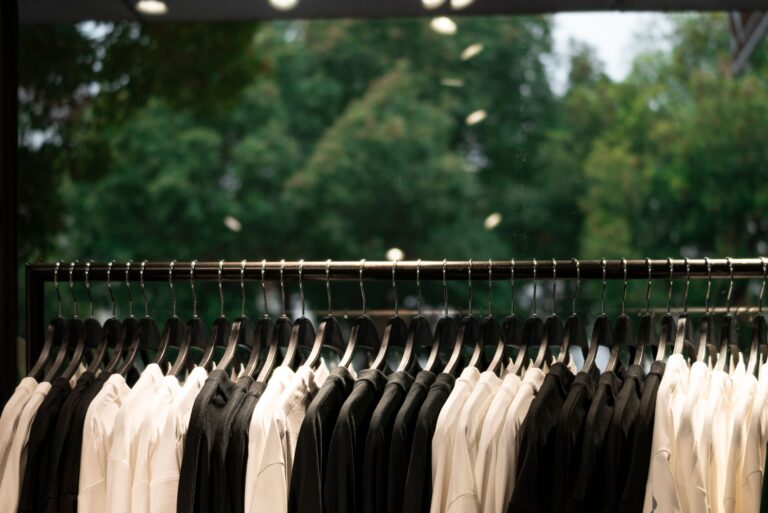
A slim body creates a different visual density from a broad shoulder profile. This affects how many garments can be displayed comfortably and how much of each item can be seen.
Neither profile is inherently better.
A structured jacket may need more shoulder support. A high-volume lightweight top program may prioritize a slimmer profile if the garment fit remains correct.
The hanger therefore influences both the individual garment and the complete rail.
Consistency Matters Across the Display
A rail can look disordered when hanger heights, hook finishes, body colors or shapes vary without a reason.
This does not require every hanger to be identical.
A retailer can use one coordinated hanger family for tops and another for bottoms while keeping visible elements consistent.
Useful controls may include:
- body color;
- hook finish;
- hook height;
- logo treatment;
- general visual language.
The objective is deliberate variation rather than accidental variation.
Surface Finish Changes the Background Around the Garment
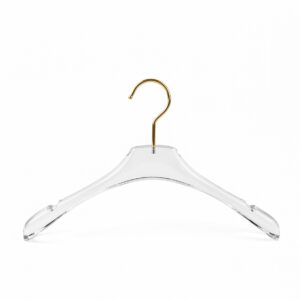
A clear hanger, black rubber coated body and molded PP hanger create different visual backgrounds.
That difference can matter in a premium display, a mass-retail environment or a brand showroom.
The buyer should judge the finish with the actual garment and store materials rather than use labels such as “luxury” or “budget.”
Lelvion’s crystal-clear hanger range, rubber range and PP plastic range can be used as three visibly different starting points for this comparison.
Hardware Can Become Part of the Visual System
Hooks, clips and bars are not invisible.
A bright hook on a dark body may become a repeated visual line across the rail. Matching metal finishes to store fixtures can create a more coordinated result, while inconsistent hardware can make an otherwise standardized hanger set look mixed.
This is a visual observation, not a claim that one metal finish sells more clothing.
Review the complete hanger rather than approving body and hardware independently.
Branding Can Be Visible or Deliberately Subtle
A hanger logo does not have to dominate the product.
Some retailers want a visible brand mark. Others prefer branding that becomes noticeable only when the garment is removed.
Decide the role first, then choose the method and position.
For custom programs, the Lelvion OEM page separates logo, color, hardware and packing into individual decisions instead of treating “premium branding” as a single feature.
Compare Hangers Under the Same Conditions
If a retail team wants to compare two hanger options, make the comparison fair.
Use:
- the same garment;
- the same rail;
- the same lighting;
- the same viewing distance;
- similar spacing.
Then record what changes.
Does the shoulder sit differently? Does one hanger show more? Does one body create a denser rail? Does the hook draw more attention? Does the logo remain visible?
These observations can support a purchasing decision without inventing a percentage increase in “perceived value.”
Include Handling in the Comparison
A hanger that looks good in a staged photograph still has to work in daily retail operations.
Ask store staff or the project team to remove and replace the garments. Check whether the surface grips too much or too little, whether clips are easy to use and whether the hook works smoothly with the fixture.
Visual presentation and store handling should be evaluated together.
Record Observable Differences
A useful evaluation form can be simple:
| Question | Hanger A | Hanger B |
|---|---|---|
| Shoulder fit | ||
| Garment stability | ||
| Rail density | ||
| Body visibility | ||
| Hardware appearance | ||
| Logo visibility | ||
| Staff handling | ||
| Overall fit for program |
This is more defensible than a table claiming that one hanger adds a fixed percentage to garment value.
Treat the Hanger as One Part of the Retail System
Lighting, fixture spacing, garment preparation, signage and merchandising all contribute to presentation.
The hanger matters because it physically supports and frames the garment, but it does not operate alone.
A strong buying decision therefore asks whether the hanger fits the garment and the store system rather than trying to assign it a stand-alone sales effect.
For a display-sensitive project, start with the closest option in the Lelvion product range, test it with the actual garment and use the contact page to discuss color, hardware, logo or sample requirements.