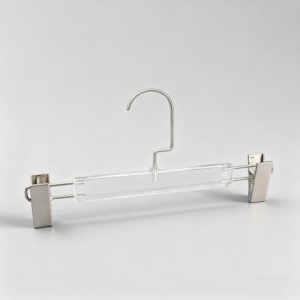

“Eco-friendly hanger” is not a complete purchasing specification.
The phrase can refer to recycled content, recyclability, reuse, reduced packaging, lower material use or another environmental attribute. Those are different claims and they require different evidence.
For B2B buyers, the safest approach is to replace broad environmental language with a specific requirement that can be written into the order.
Replace “Eco-Friendly” With a Defined Objective
Start by asking what the project is trying to achieve.
Examples include:
- require a defined recycled-content percentage;
- use a particular polymer or material system;
- reduce unnecessary packaging;
- simplify material composition;
- support a reuse program;
- meet a customer-specific sourcing policy;
- document environmental attributes for reporting.
Once the objective is clear, the supplier can answer a real requirement rather than a marketing phrase.
Identify the Materials in the Complete Hanger
A hanger may contain more than one material.
Separate the components:
| Component | Procurement question |
|---|---|
| Body | Which polymer or material? |
| Hook | Which material and finish? |
| Clips / springs | What additional materials are present? |
| Coating | Is there a separate surface treatment? |
| Logo component | Printed, engraved or applied part? |
| Packaging | What materials are used around the product? |
A material claim about the plastic body should not automatically be applied to the metal hook or packaging.
This is especially important when a percentage is involved.
Recycled Content Is a Specific Claim
If recycled content matters, define:
- the percentage required;
- the component to which it applies;
- whether the buyer distinguishes post-consumer and pre-consumer material;
- what documentation is required.
Do not treat “contains recycled plastic” as equivalent to a clearly specified percentage.
The separate article on virgin versus recycled plastic hangers explains what a sample can and cannot verify and how to document the requirement.
Recycled and Recyclable Are Different Claims
A hanger can contain recycled material without being easily recyclable in the destination market.
A hanger can also use a material that is technically recyclable but never enter a practical collection and sorting route.
Do not treat these terms as interchangeable.
If recyclability matters, ask:
- what materials are present;
- whether different components can be separated where relevant;
- what end-of-use system exists in the destination market;
- whether the buyer’s own collection program changes the situation.
Avoid writing “100% recyclable” simply because the main body polymer can theoretically be recycled.
Do Not Use “Plastic vs Metal” as a Sustainability Shortcut
Plastic and metal hangers can have different materials, weights, production processes and service models.
A general statement that one material is always more sustainable than the other is too broad for a purchasing guide.
The meaningful comparison needs a defined product and system boundary.
For example, a reusable hanger retained inside a store network is a different use case from a hanger given to customers and discarded after one use.
The buyer should evaluate the actual program instead of relying on a material stereotype.
Evaluate Reuse Without Inventing a Lifespan
If the hanger will be reused, define the reuse scenario.
Ask:
- Does the hanger remain in the store?
- Does it move through distribution with the garment?
- Does the customer take it home?
- Is there a return system?
- How are damaged hangers removed?
Do not claim that a hanger “lasts five years” or survives a fixed number of cycles unless there is a defined test or operating record supporting that statement.
For procurement, the operational model is more useful than a generic lifespan number.
Packaging Deserves Its Own Review
Environmental discussions often focus on the hanger and ignore the carton, bags, dividers or protective material around it.
Review whether each packaging component is needed for protection and handling.
The objective is not to remove packaging blindly. A poorly protected surface can create damaged goods and waste.
Instead, specify the minimum packing that reliably protects the approved hanger through the intended shipment and receiving process.
For high-volume orders, also record pieces per carton and carton dimensions because packing decisions affect freight volume.
Ask for Evidence That Matches the Claim
Do not collect certificates simply because the project uses the word “sustainable.”
Match the evidence to the requirement.
If the claim is recycled content, request evidence relevant to recycled content.
If the claim is a material specification, document the material.
If the claim relates to packaging, keep the packaging evidence separate.
If the buyer intends to make a public environmental claim, involve the appropriate internal legal, compliance or sustainability team before repeating supplier language externally.
Broad statements such as “green,” “environmentally friendly” or “good for the planet” should be avoided unless the buyer has a credible basis for the full claim.
Use Samples for Product Approval, Not Environmental Proof
A sample remains essential because the hanger still has to work.
Use it to approve:
- dimensions;
- garment fit;
- body color;
- surface;
- hook and clips;
- logo;
- packing appearance.
But do not assume a visual sample proves a recycled-content percentage or complete environmental profile.
Physical approval and claim documentation are separate parts of the purchase file.
Build Environmental Fields Into the RFQ
A practical RFQ can include:
| Field | Buyer requirement |
|---|---|
| Hanger model / garment use | |
| Body material | |
| Recycled-content requirement | |
| Claim scope | Body / component / packaging |
| Hook / clips | |
| Surface treatment | |
| Packaging | |
| Required documentation | |
| Sample approval | |
| Destination |
This turns a vague sustainability conversation into information a supplier can actually confirm.
Do Not Sacrifice Product Suitability for a Marketing Claim
A hanger still needs to fit the garment, work on the fixture and survive the handling expected in the program.
If an environmental requirement causes the buyer to change material, body or packing, retest the finished product.
The objective is not to choose the hanger with the most environmental vocabulary. It is to select a product that meets the defined use and the defined environmental requirement with evidence appropriate to the claim.
Keep Public Claims Narrower Than the Evidence
If the available evidence supports only a statement about recycled content in the plastic body, say that.
Do not expand it into a claim about the complete product’s total environmental superiority.
Specific claims are easier to verify, easier for suppliers to understand and safer for buyers to repeat.
Buyers who want to discuss a Lelvion hanger program should first identify the closest product in the hanger range, then state the environmental requirement alongside the garment, quantity, color, hardware and packaging fields. Send that brief through the contact page so the material discussion remains tied to a real product configuration.