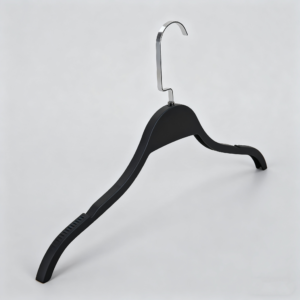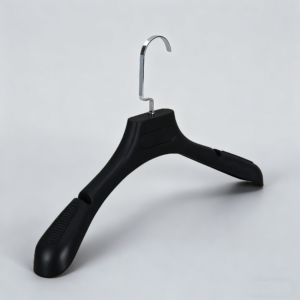
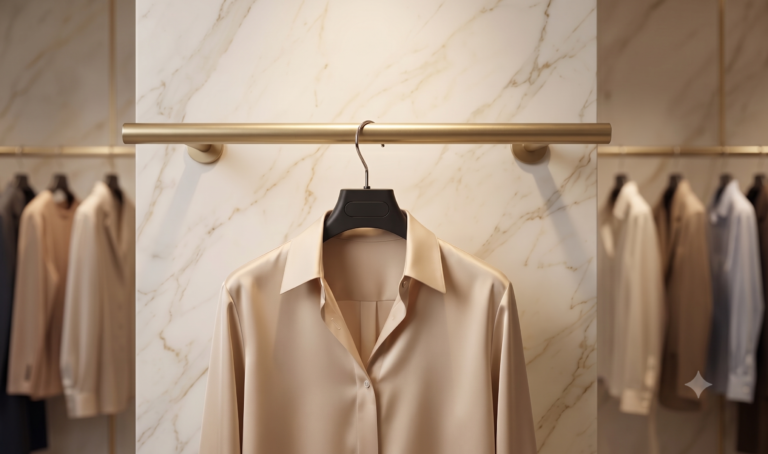
Rubber coated hangers are often described as premium or luxury products.
That description is too broad to help a buyer choose one.
The useful question is whether the rubberized surface solves a real problem for the garment or the retail presentation.
In some programs it does. In others, a simpler molded hanger may work just as well.
Start With the Problem the Finish Is Supposed to Solve
A rubberized surface is most useful when the buyer has a reason to want more grip or a particular matte visual finish.
Common situations to test include:
- wide necklines;
- thin straps;
- smooth fabrics;
- garments that move easily on conventional smooth shoulders;
- branded retail programs where a matte coated appearance is part of the visual brief.
Do not choose the finish simply because the word “rubber coated” sounds more premium.
Grip Does Not Replace Correct Fit
If the hanger is too narrow or too wide for the garment, more friction does not solve the geometry problem.
Start with shoulder fit.
Check the garment on the proposed body. Only after the shape is acceptable should the buyer decide whether the surface grip improves the result.
This sequence prevents a surface treatment from being used to compensate for the wrong hanger body.
Test Smooth and Slippery Garments in Normal Handling
Do not test only by leaving the garment still on a rail.
Lift the hanger, move it along the fixture, remove it and return it. Check whether the garment stays in the intended position.
For a wide neckline or strap garment, pay attention to where the fabric contacts the shoulder.
If a different body shape or notch would solve the problem more directly, compare that option as well.
Surface Finish Also Changes Appearance
A rubber coating can create a matte, visually quieter surface compared with a glossy molded body.
That can work well in some retail interiors, especially where the hanger is intended to recede behind the garment or coordinate with dark fixtures.
It is still an aesthetic choice, not proof of higher retail value.
Review the sample in-store or under similar lighting before standardizing it across a program.
Compare Rubber Coated Against Other Suitable Hangers
A useful sourcing test might include:
- one rubber coated option;
- one smooth molded option;
- one alternative shape if fit is uncertain.
Put the same garment on each.
Compare:
| Question | Option A | Option B | Option C |
|---|---|---|---|
| Shoulder fit | |||
| Garment stability | |||
| Ease of loading | |||
| Ease of removal | |||
| Appearance | |||
| Hook / hardware fit |
This creates a product decision rather than a material preference.
Check Repeated Handling
A retail hanger will not remain untouched.
Store staff load garments, customers browse, fitting rooms return items and visual teams rearrange rails.
During sampling, repeat the normal handling sequence enough times to notice practical issues.
Does the surface grip the garment appropriately? Does it also make unloading awkward? Does the finish remain visually acceptable under ordinary handling?
The test does not need an invented number of cycles unless the buyer has a formal test method. The objective is to reproduce realistic use before placing a large order.
Coordinate the Surface With Hardware and Branding
A rubber coated body, metal hook and logo are seen together.
Confirm the body color, hook finish and branding on the final sample.
Selected Lelvion rubber coated models publish customization options for hook finishes and several logo methods. Buyers should confirm availability for the exact model rather than assume every option applies across the whole category. The current range can be reviewed on the rubber coated hanger category page.
For branded projects, use the OEM page to define color, logo, hardware and packaging as separate fields.
Rubber Coated May Be Unnecessary in Some Programs
A conventional PP or other smooth molded hanger can be the better choice when:
- the garment already stays stable;
- the buyer wants a simple high-volume standard hanger;
- the visual brief does not require a coated surface;
- easier loading and unloading is more important than extra grip;
- the coating adds cost or complexity without solving a problem.
A supplier should be able to discuss this possibility rather than automatically recommend the more customized option.
Lelvion’s PP plastic hanger range can be compared with the rubber range when the buyer is not yet sure which surface is appropriate.
Put the Finish Into the Written Specification
Once the sample is approved, record:
- base hanger model;
- body material;
- rubberized finish requirement;
- body color;
- hook configuration;
- logo method and artwork;
- packing;
- approved sample reference.
“Same rubber coated as last time” is not a strong repeat-order instruction without a product reference.
Use Rubber Coated When It Has a Job to Do
The best reason to choose a rubber coated hanger is not that it sounds premium.
It is that the selected body and finish work better for the garment and retail program than the available alternatives.
Buyers can shortlist models on the Lelvion rubber category page and send the garment category, quantity, color, hook and branding requirements through the contact page for sample discussion.