Retail formats create different operating conditions, but labels such as “fast fashion” and “boutique” should not be turned into rigid hanger rules.
A high-volume store can use carefully branded hangers. A boutique can still need efficient replenishment. Two retailers in the same segment may have very different garment mixes and fixture systems.
The useful comparison is therefore based on how the store operates.
Start With the Operating Model
Ask what the hanger needs to support in daily use.
Relevant questions include:
- How quickly does merchandise turn over?
- How often do staff replenish the rail?
- How dense is the assortment?
- Are hangers customer take-home items or store assets?
- Is the hanger highly visible in the brand presentation?
- How many garment categories share the same fixture system?
These questions create a better specification than deciding that one retail label automatically requires one hanger type.
High-Volume Assortments May Prioritize Standardization
Where a retailer handles many units and frequent replenishment, a smaller number of standardized hanger types can simplify purchasing, storage and store operations.
That does not mean using one hanger for every garment.
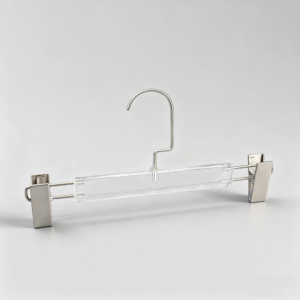
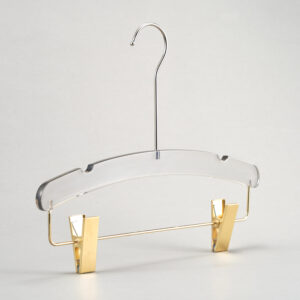
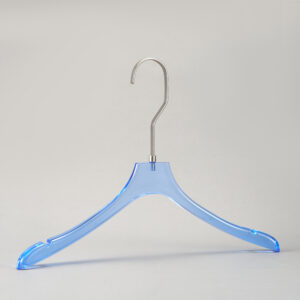
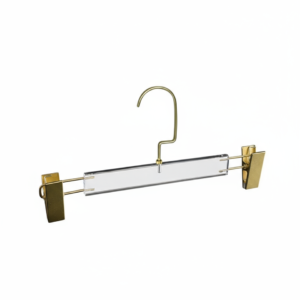
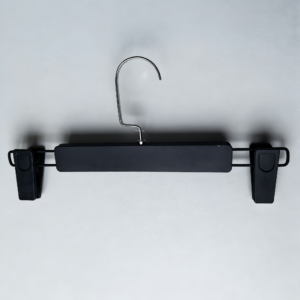
A practical program might standardize one top hanger, one structured-garment hanger and one bottom hanger while keeping body color and hook finish coordinated.
The objective is to reduce unnecessary variation without forcing poor garment fit.
Curated Displays May Give More Weight to Visible Detail
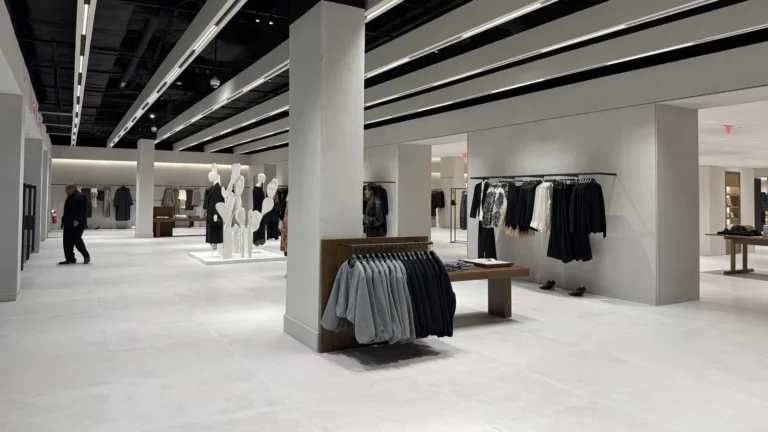
A lower-density or more curated store may choose to control visible hanger details more closely.
Body finish, hook finish, logo size and color can become more noticeable because the display contains fewer competing products.
That still does not justify adding decoration without a reason.
The premium retail hanger guide explains how to turn visual choices into a repeatable specification rather than a vague “luxury” requirement.
Rack Density Changes the Hanger Decision
A high-density program may value a slim profile where garment fit allows it.
A curated display may accept a broader shoulder profile if it supports structured clothing and the fixture has enough space.
The correct choice depends on garment and fixture, not the retail label.
Use the rack density guide to test real garment-and-hanger combinations rather than copying a spacing number from another store.
Handling Frequency Matters
A hanger that is touched frequently by staff and customers needs to work smoothly in daily use.
Check whether garments can be loaded and removed efficiently, whether clips are practical, whether a high-grip finish makes handling easier or harder for the specific garment, and whether the hook works with the rail.
A showroom or presentation space may have a different handling pattern.
Again, the operational condition should drive the choice.
Branding Strategy Can Differ by Program
Some retailers want the hanger to disappear behind the garment.
Others want a visible branded element.
A large chain may prefer a standard subtle logo across many stores because it is easier to maintain. A curated brand environment may use a more visible color or hardware combination.
Do not assume “boutique = logo everywhere” or “mass retail = no branding.”
Define what the hanger needs to communicate and how consistently the business can maintain it.
Replenishment and Replacement Need to Be Considered
A highly customized hanger can look distinctive but may also create more replacement complexity if the program contains many small variants.
A retailer should ask:
- Can replacement hangers be reordered easily?
- Are several stores sharing the same model?
- Does a custom color create separate inventory?
- Will a seasonal design disappear after one collection?
The most visually interesting hanger is not always the most practical choice for the whole network.
Compare Requirements by Scenario
| Requirement | High-volume program | Curated / lower-density program |
|---|---|---|
| SKU count | Often benefits from tighter standardization | May tolerate more variation |
| Rack density | Often more operationally important | May allow more space per garment |
| Branding | Can be subtle and standardized | May be more visible if deliberate |
| Handling | Frequent replenishment may matter more | Handling may be lower-frequency |
| Replacement | Ease of replenishment can be important | Smaller volumes may be manageable |
| Hanger profile | Slim where garment fit allows | Broader profiles may be acceptable |
These are tendencies to evaluate, not universal rules.
Do Not Copy Another Retailer’s Hanger Program Blindly
A competitor’s hanger may be designed around different garments, fixtures, quantities and supply arrangements.
Use it as a visual reference if useful, but rebuild the specification around your own program.
The first test should still be the garment on the hanger.
Build a Retail-Format Brief for Suppliers
A useful sourcing brief can state:
- store format and fixture type;
- garment categories;
- expected hanger family;
- desired body color and finish;
- hook / clip requirements;
- branding visibility;
- quantity by model;
- replacement / reorder expectations.
This gives a supplier enough context to recommend a relevant existing model rather than simply sending the full catalogue.
Lelvion buyers can compare rubber coated, PP plastic and crystal-clear options, then use the contact page to send the garment mix and retail-use brief for model selection and sampling.